



On Wednesday March 11th the Loudoun County Regional Science and Engineering fair was held at Tuscarora High School, then on Thursday March 12th the winners were announced from the 22 different categories. Luke Battaglia won the entire fair, as well as 4 other awards.
Battaglia’s project on thrust vector control for guidance of high power rockets, focused primarily on improving how rockets steer in flight. He explained, “It’s a rocket that is able to steer itself by gimbaling its own engine, and that allows it to control what trajectory it goes on.”
He chose this topic because many rockets cannot adjust their paths effectively at high altitudes. “A lot of missiles use fins to control themselves, but the missiles with fins, they stop working like high up in the atmosphere,” he explained.
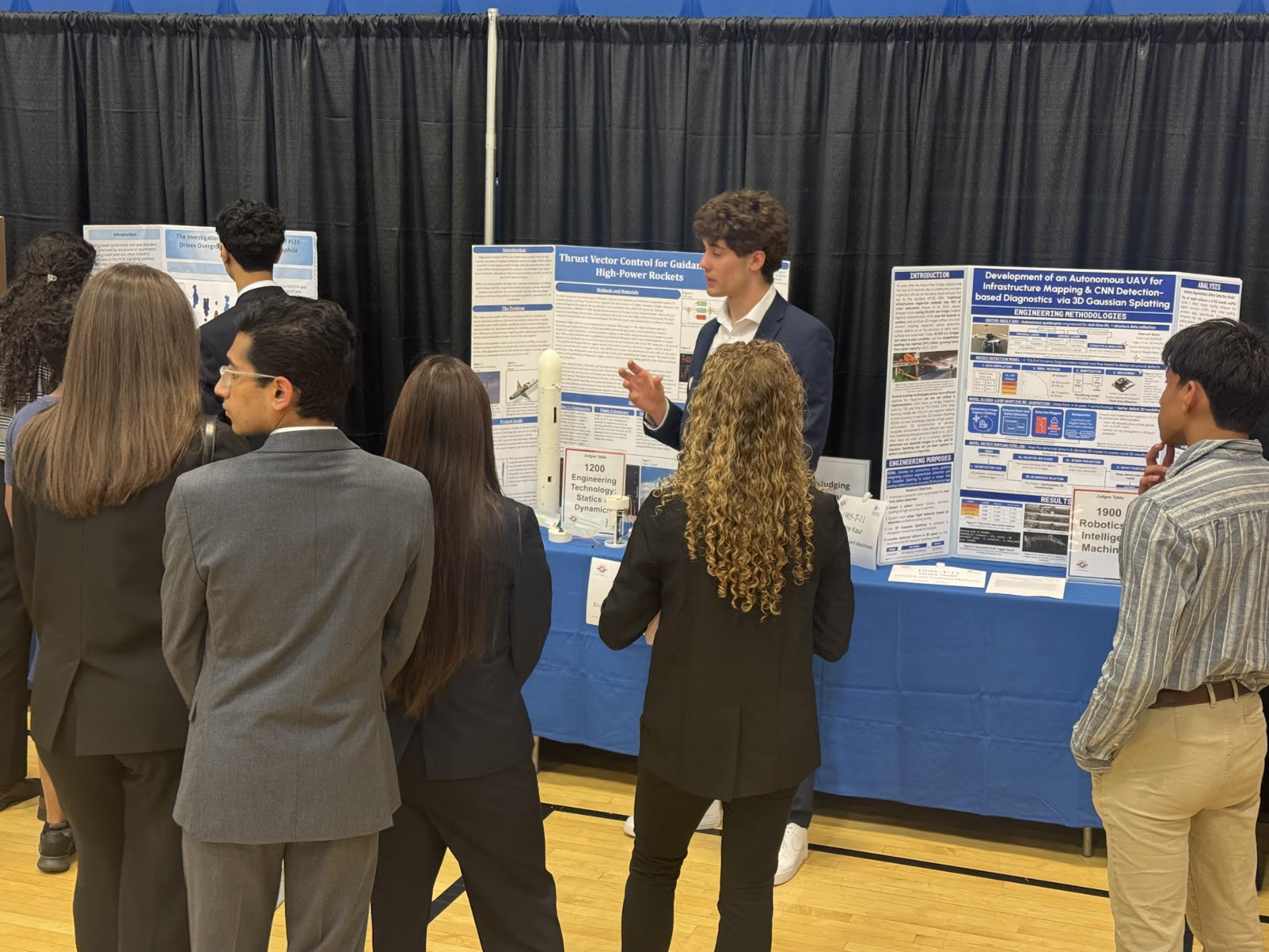
Battaglia won five awards in total, including first place in engineering, which qualifies him for the Virginia State Science Fair. He also won the American Institute of Aeronautics and Astronautics Award that makes him a member of the American Institute of astronautics and Aeronautics until he graduates high school along with having the experience to take a tour of NASA’s Goddard facility. He also won awards in the Institute of Electrical Electrical and Electronics Engineers, Aerospace Herndon award, and the US Air Force award.
Beyond advancing rocket technology, Battaglia noted broader scientific benefits. By improving control systems, rockets could better study hard-to-reach atmospheric regions like the mesosphere, the least explored region of Earth’s atmosphere. He pointed out that research in these areas could help scientists better understand climate change.
Karen Wolfson, his Physics teacher, is his sponsor because in order to be eligible to do a project and be in the fair you need a sponsor to help you with your project. Wolfson said, “He [Battaglia] did it all on his own. During 2020 he and his dad started working on some rocketry things in his backyard and it inspired him to do this.”
Despite being at the science fair and working on this project, Battaglia is not enrolled in the Dual Enrollment class, ISR. This came with some challenges. “One of the biggest obstacles was that I had to do everything in my free time,” Battaglia said. He balanced school work with long weekends spent making his design and preparing the final details for competition.“I had to budget my time a lot better than like ISR kids would because I had to do this outside of school,” Battaglia said.
ISR teacher Denise Wingfield helped guide Battaglia on his journey in order to qualify for the fair. There is no guarantee you go to fair, Dominion only has a certain number of spots. Wingfield said, “We had meetings, check-ins I called them because his stuff was rocketry and it was outside so we had to talk about what was allowed and what was not allowed and the number of trials that he should have in order to make his research statistically valid, as in you don’t run a test two times and know what happens.”
The project originally began simply as a personal interest. “Originally, I just wanted to do something like this out of fun,” he said. Over time, however, he realized it had the potential to become a meaningful science fair project, “Pretty quickly I realized I could turn this into a science fair project, and something that could actually have real world applications,”Battaglia said.
At the fair, Battaglia found the experience rewarding. “It was really good. I talked to a lot of judges. It was really exciting,” he said. His efforts earned significant recognition.
After you win or receive any placement in your category there is an award ceremony the day after the fair which was on Thursday March 12th. Wingfield explained, “We have an award ceremony which is the day after the fair, and that’s where he [Battaglia] was awarded his prizes. You get a monetary award for first place, as you do for second and third place, then there are a whole bunch of special awards. We have a lot of technology around Loudoun County, he won some special awards from space organizations, people that do rocketry research, he got special awards too.”
Looking ahead, Battaglia hopes to pursue aerospace engineering in college and continue expanding his research. He plans to take ISR next year and work toward building “a bigger rocket, a better rocket, that has a lot more applications than what I’m working on right now,” he said.
Now that the fair is over, Battaglia is done with his rocketry research project and will start a new project in his ISR class once he is officially enrolled in the class. Wingfield said, “It makes me very happy that he’ll be back next year in ISR, it’s cool because ISR is for seniors only and you very rarely get to do a research project where you get to continue it. Now because of his love of rockets, he can’t do the exact same thing he did this year because if you have a continuation project there has to be some difference in what you do the next year. He’s a great young man and anyone who’s that self motivated to do research, I say it very affectionately they’re my science nerds.”
Despite not being enrolled in the course this year, Battaglia really encourages other students to explore ISR projects. Reflecting on his experience, he said, “Everyone should take ISR, I haven’t done ISR, but it [the project] was really fun. So I just encourage everyone to do something like this.”


