



After the murder of Renee Good by an Immigration and Customs Enforcement (ICE) agent on January 7, 2026, students throughout LCPS, including Dominion High school, have organized a walkout for January 20, exactly one year after Donald Trump was inaugurated president. However, there are regulations students are expected to adhere to during the walkout, and potential consequences for not following LCPS policy.
Dominion walkout organizers SCA President Ant Rodriguez and Alex Cho have planned for students to leave class at 2:00 p.m. and walk around the school counterclockwise at 2:05 p.m. By 2:15, they plan for students to be at the front of the school for a speech by Rodriguez. Students should promptly return to class at 2:30.
While LCPS Policy 8273 does permit walkouts, it does not allow “substantial disruption or material interference with instructional time, school activities, or an invasion of the rights of others. Students who participate in any demonstrations must do so in a peaceful and orderly manner.”
Students who miss an assessment during a walkout will be allowed to make up the assessment. Principal Dr. Brewer notified teachers in advance of the planned walkout and advised them to plan accordingly.
Superintendent Dr. Aaron Spence explained, “I believe philosophically students have a right to express themselves, to protest, to engage in civic activity, and we have an obligation to ensure two things: one, that there is not a disruption to the learning environment, and two, that our students are safe. And our policies are driven to make those things happen.”
Spence defined what students can and cannot do to protest. “You can’t get up and protest in class. You can’t just walk out of class while class is going on. If you do, you have to understand that there’s a consequence with that. Essentially, you’re skipping class. Basically what the courts would say about this is if you interrupt learning and it’s kind of a willful thing, then the schools can intervene and put an end to it,” Spence said.
While Spence recognized students’ rights to civil protest, it will still be considered an unexcused absence for any student who participates in a demonstration during class time in accordance with the LCPS Student Rights and Responsibilities for Families and Student Code of Conduct (SR&R).
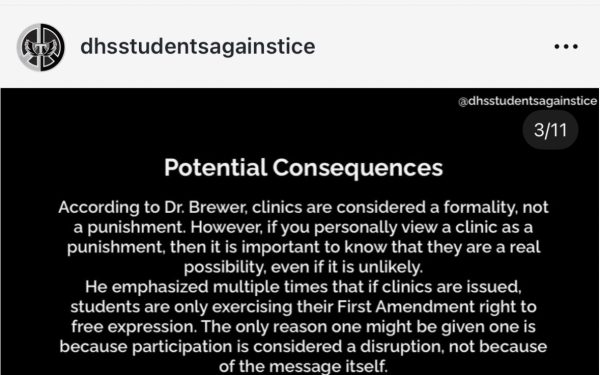
In regards to the origin of current walkout policies, Spence referenced Tinker v. Des Moines, “a historic Supreme Court ruling from 1969 that cemented students’ rights to free speech in public schools,” according to the ACLU.
Spence explained that his obligation and job is to ensure people’s safety. “That’s why when we ask for students to go to a specific place- like, for example, in some of the protests that have happened since then, students have gone to the track. Well, that’s a contained area that the administrators can supervise. You still have the opportunity to go protest, you’re still heard, but we can make sure that you’re not interacting with people in the public that might want to harm you.”
Signs, flags, pictures, banners, and all other visual props are not permitted during the walkout in accordance with Policy 8273. “The reason for that is because we can’t control the content of that, and we have had instances where there’s been hate speech on the signs, and we have made the determination with our legal counsel that by prohibiting that, we prohibit the instances of hate speech that have been demonstrated that they can happen,” Spence said.
Teachers are expected to allow their students to walk out. Spence explained, “I think a teacher based on our policy probably ought to allow a student to leave the class and then refer that student to the administration for follow up. I would prefer our teachers not engage in conflict with our students over this.”




BlaHo • Jan 20, 2026 at 9:47 pm
Great article!